


Industrial manufacturing relies heavily on fasteners to hold structures together,transmit loads,and maintain alignment.Among all fastening solutions,Bolts play a central role due to their strength,versatility,and reliability.Choosing the right type of bolt is not only a technical decision but also a strategic one that affects product durability,safety,and maintenance costs.
In most factories and construction sites,standard Bolts are the foundation of assembly work.These bolts are designed according to international standards such as ISO,DIN,or ANSI,ensuring dimensional consistency and global compatibility.A standard bolt is typically a metal bolt with a hex head and a fully or partially threaded shank.Because of their universal design,standard bolts are widely stocked and easy to replace,making them ideal for mass production and industrial maintenance.
Hex bolts are among the most commonly used industrial bolts.Their six-sided head allows easy tightening with standard tools,ensuring controlled torque application.In heavy machinery,steel structures,and automotive assemblies,hex bolts are often selected for their balance of strength and ease of installation.When combined with the appropriate nut and washer,a hex bolt fastener system can withstand high vibration and dynamic loads.
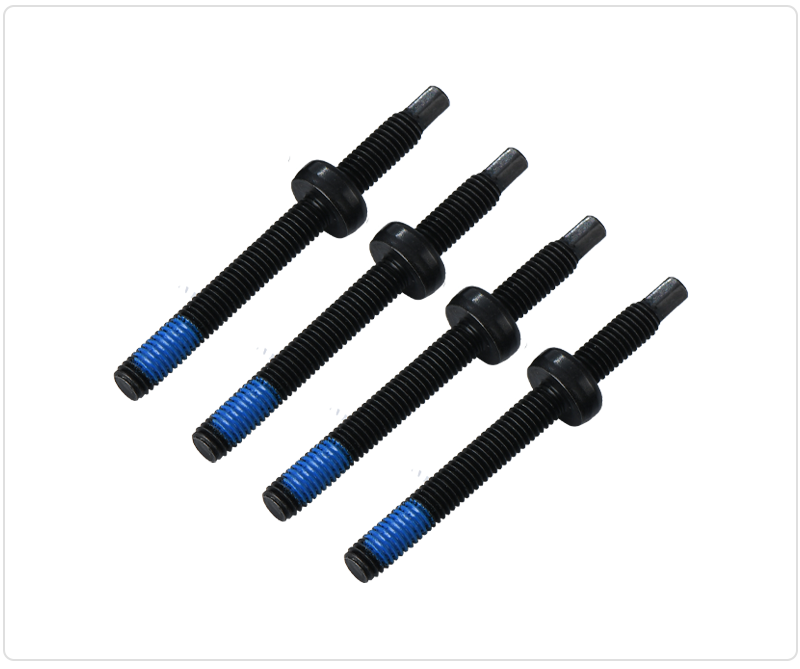
Another important category includes structural bolts,which are specifically engineered for high-strength applications.These industrial bolts are commonly used in steel construction,bridges,and large-scale infrastructure projects.Structural bolts are manufactured from high-grade alloy steel and often feature precise heat treatment to achieve superior tensile strength.Compared to general standard bolts,structural bolts offer enhanced performance under extreme stress conditions.
Flange bolts are also widely used in industrial manufacturing.A flange bolt integrates a washer-like flange beneath the head,which helps distribute load and reduce surface damage.This design eliminates the need for a separate washer,improving assembly efficiency.In automotive and equipment manufacturing,flange bolts are preferred where consistent clamping force and vibration resistance are required.
For applications requiring corrosion resistance,stainless steel bolts play a vital role.These metal bolts are commonly used in outdoor equipment,food processing machinery,and chemical plants.Stainless steel industrial bolts provide excellent resistance to rust and chemical exposure,making them suitable for harsh environments.Although their strength may differ from alloy steel bolts,their durability and low maintenance requirements often outweigh this limitation.
Socket head bolts represent another essential group of industrial bolts.Featuring an internal hex or Torx drive,these bolts allow for compact assembly in tight spaces.Socket head bolts are frequently used in precision machinery and automation systems,where space constraints and alignment accuracy are critical.Despite their smaller head size,these bolts can deliver impressive clamping force when properly installed.
From a sourcing perspective,understanding bolt types helps buyers align specifications with actual usage.Many manufacturers offer both standard bolts and custom bolt fastener solutions.Custom bolts may involve unique head designs,special thread lengths,or specific surface treatments such as zinc plating or black oxide coating.These variations allow industrial bolts to meet application-specific requirements without compromising performance.
Material selection further defines bolt performance.Carbon steel bolts are commonly used for general applications due to their cost-effectiveness.Alloy steel bolts provide higher strength for demanding environments,while stainless steel bolts focus on corrosion resistance.Regardless of material,a high-quality metal bolt must meet strict dimensional tolerances and undergo quality inspection to ensure reliability in industrial use.
In modern manufacturing,bolts are more than simple fasteners—they are critical components that ensure structural integrity.Whether choosing standard bolts for routine assembly or specialized industrial bolts for high-load applications,understanding bolt types allows buyers to make informed decisions.With the right bolt fastener selection,manufacturers can achieve safer designs,longer service life,and more efficient production processes.
