


If you are designing automated machinery,linkage mechanisms,or stamping dies,standard fasteners usually won't cut it.When an assembly needs a joint that can act as a pivot point,a rotating shaft,or a slide guide—while still holding everything together—you reach for a Socket Head Shoulder Screw(often called a shoulder bolt or stripper bolt).
What sets this fastener apart from a standard machine screw is its stepped design.Instead of being threaded from tip to head,it is split into three distinct,engineered sections:the head,the shoulder,and the threaded tip.Each plays a specific role in how the assembly moves and handles mechanical loads.
The Drive and Clearance:The Socket Head
At the very top sits the cylindrical head,featuring a recessed hexagonal drive.Its primary job is to provide a solid mechanical stop and accept the torque needed for installation via an Allen wrench or hex key.
Because the head is compact and perfectly round,it is ideal for counterbored holes.Designers can sink the head flush with or below the material surface.This keeps the layout clean,saves space in tight enclosures,and prevents moving parts from catching on a protruding bolt head.
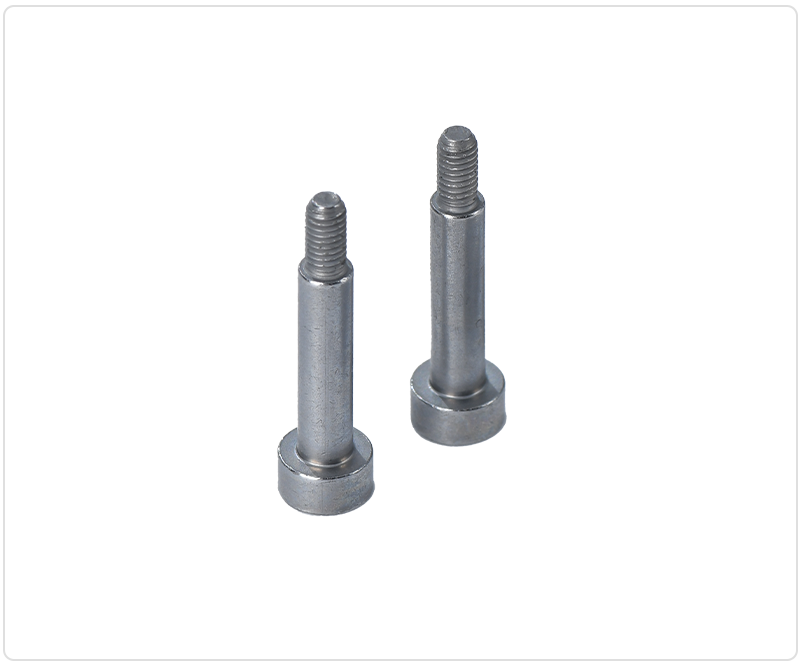
The Working Surface:The Unthreaded Shoulder
Right beneath the head is the smooth,unthreaded cylindrical section known as the shoulder.This is the defining feature of the fastener.
The shoulder essentially acts as a localized shaft or dowel pin.Linkages,pulleys,or guide plates mount directly onto this smooth surface,allowing them to rotate or slide freely.If you tried this with a standard screw,the sharp,abrasive threads would quickly grind away at the mating parts.
Since it dictates the alignment of moving parts,the shoulder diameter is held to incredibly tight tolerances—typically ground within a few ten-thousandths of an inch(or standard metric fits like f9 or h8)to eliminate unwanted wobble or play.Note that when sourcing these screws,the catalog"length"always refers to this smooth shoulder,not the entire length of the fastener.
The Anchor:The Threaded Tip
At the very end of the screw is the threaded portion.You will notice it has a noticeably smaller diameter than the shoulder,which creates a sharp"step"or ledge where the two sections meet.
The threads do only one thing:anchor the fastener into a tapped hole or a mating nut.
However,the magic lies in that stepped transition.When you torque the screw down,this ledge bottoms out firmly against the mounting wall.Because the shoulder is wider than the threaded hole,the screw stops dead in its tracks.No matter how tightly you cinch it down,you will never crush,bind,or clamp the moving component riding on the shoulder,ensuring its freedom of movement is completely preserved.
