


Machine tools are the foundation of modern manufacturing.Equipment such as CNC machining centers,milling machines,lathes,and grinding machines rely heavily on stable structural assemblies to maintain machining accuracy and operational safety.In these complex mechanical systems,fastening components play an essential role in ensuring that every structural part remains securely connected.Among the most commonly used fastening components in machine tool structures are Hexagonal Studs.
In machine tool manufacturing,structural components must withstand continuous vibration,heavy loads,and long operating hours.Ordinary fasteners may loosen or wear over time,which can affect machining precision.For this reason,many manufacturers prefer using Hexagonal Studs as a reliable fastening solution in structural assemblies.The design of hexagonal studs allows them to provide stronger thread engagement and better load distribution compared with traditional Bolts.
One of the most important applications of hexagonal studs in machine tools is the connection of the machine frame.The frame supports the entire equipment structure and must maintain high rigidity during operation.By installing high-strength hexagonal studs between structural plates and supporting components,manufacturers can ensure that the frame remains stable even under high cutting forces.This helps prevent deformation and improves the long-term reliability of the machine tool.
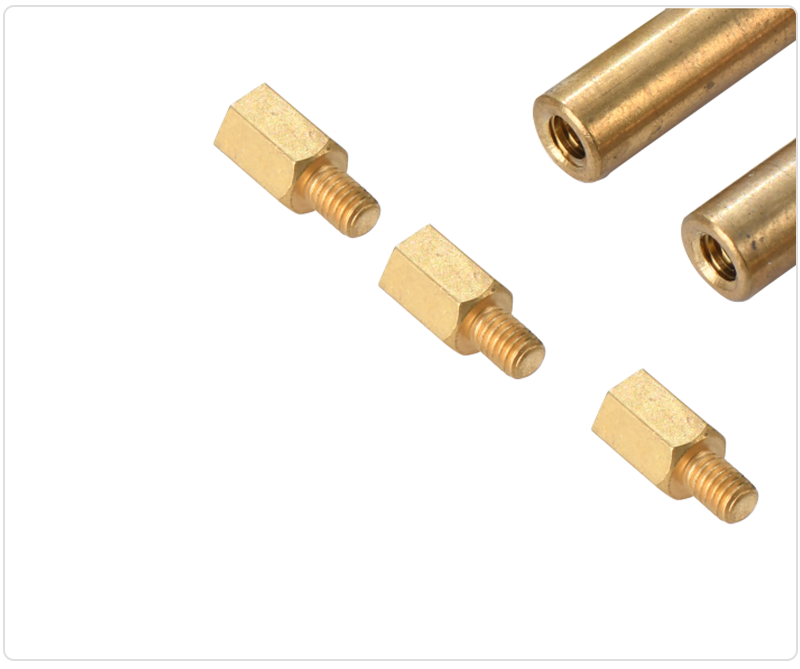
Another common use of hexagonal studs is in the installation of motors and transmission systems.Machine tool motors generate continuous rotational force,and even small alignment deviations can affect performance.Hexagonal studs help maintain precise positioning when connecting motors to the equipment base.Because studs remain fixed in the base structure,they allow components to be positioned accurately before tightening nuts,which simplifies the assembly process and reduces installation errors.
Equipment housings and protective covers are also frequently assembled using hexagonal studs.Machine tools often require removable panels for maintenance and inspection.In these cases,studs provide a convenient solution because they remain permanently installed in the base material.Technicians can easily remove nuts to access internal components without damaging threads,making maintenance faster and more efficient.
In addition,hexagonal studs are widely used in mold fixtures and auxiliary equipment installed on machine tools.These applications require precise positioning and strong clamping force.The dual-thread design of studs allows them to hold components securely while maintaining alignment accuracy.This is especially important in precision manufacturing environments where even small movements can affect machining quality.
Material selection also plays an important role in the performance of hexagonal studs used in machine tools.Many manufacturers choose high-strength alloy steel studs to withstand mechanical stress and vibration.Stainless steel studs may also be used in environments where corrosion resistance is required.Surface treatments such as zinc plating or black oxide coating can further enhance durability.
Overall,hexagonal studs have become an essential fastening component in machine tool structural assembly.Their ability to provide strong clamping force,accurate alignment,and easy maintenance makes them highly suitable for industrial equipment.For machine manufacturers and maintenance engineers,selecting high-quality hexagonal studs is an important step in ensuring equipment stability and long service life.
