


When installing industrial machinery,the base mounting system plays a critical role in ensuring stability and safety.The base supports the entire machine and transfers operational loads to the foundation.Selecting the correct fastening components is therefore essential for maintaining equipment alignment and preventing structural problems.Among the different fastening options available,Hexagonal Studs are commonly used for machine base mounting because of their strength and reliability.
Choosing the correct size of Hexagonal Studs is an important part of the installation process.If the stud diameter is too small,it may not provide sufficient load capacity.If the stud is too large,it may increase installation difficulty and unnecessary material costs.Engineers typically select stud sizes based on factors such as machine weight,load distribution,and base material strength.
For many industrial machines,medium-sized hexagonal studs such as M12 or M16 are commonly used.These sizes provide a good balance between strength and installation convenience.They are widely used for mounting equipment such as CNC machines,milling machines,and medium-sized industrial machinery.For heavier equipment with higher load requirements,larger studs such as M20 or M24 may be required to ensure structural stability.
Machine weight is one of the primary factors that determines the appropriate size of hexagonal studs.Light equipment may only require smaller studs,while large industrial machines may require multiple high-strength studs to support the load.Engineers often calculate the total weight of the machine and distribute the load across several mounting points to determine the required stud diameter.
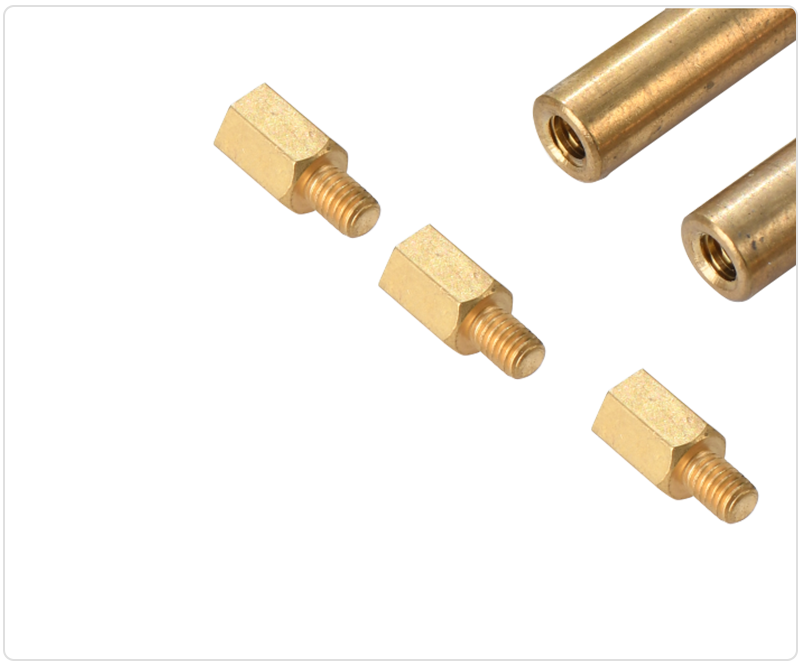
Another important consideration is the strength of the base material.Machine bases may be mounted on steel frames or concrete foundations.The selected hexagonal studs must provide sufficient thread engagement in the base material to ensure secure fastening.Proper thread depth allows the stud to fully transfer loads without damaging the surrounding structure.
Thread engagement length is also important when selecting hexagonal studs.In general,the thread engagement should be long enough to ensure strong clamping force while preventing thread stripping.Proper engagement improves the mechanical strength of the connection and helps maintain stability during machine operation.
Material selection further affects the performance of hexagonal studs used in base mounting.Carbon steel studs are commonly used for standard applications,while high-strength alloy steel studs are preferred for heavy equipment.In environments where moisture or chemicals are present,stainless steel hexagonal studs may be used to prevent corrosion and ensure long-term durability.
Ultimately,selecting the correct size of hexagonal studs helps ensure that machines remain securely mounted and properly aligned during operation.Properly sized studs not only improve equipment stability but also reduce maintenance problems and extend the lifespan of industrial machinery.
For equipment manufacturers and installation engineers,understanding how to choose the right hexagonal studs is an important part of building reliable mechanical systems.High-quality studs with appropriate size and material can significantly improve the safety and performance of machine installations.
