


What Is the Difference Between Socket Head Shoulder Screws and Shoulder Bolts?
When sourcing industrial fasteners, many engineers and buyers ask the same question: Are Socket Head Shoulder Screws and Shoulder Bolts the same product? Although these terms are often used interchangeably, they are not always identical. Understanding the differences in precision, design, applications, and manufacturing standards can help you choose the right fastener for your project while improving equipment reliability and reducing maintenance costs.
Quick Answer
Socket Head Shoulder Screws vs Shoulder Bolts: Quick Comparison
| Feature | Socket Head Shoulder Screws | Shoulder Bolts |
|---|---|---|
| Precision | High | Standard to High |
| Manufacturing Tolerance | Tight | Standard |
| Main Function | Positioning & Rotation | General Fastening |
| Common Applications | Automation, Robotics, CNC | Industrial Equipment, Fixtures |
| Customization | Extensive OEM Options | Standard & Custom |
What Are Socket Head Shoulder Screws?
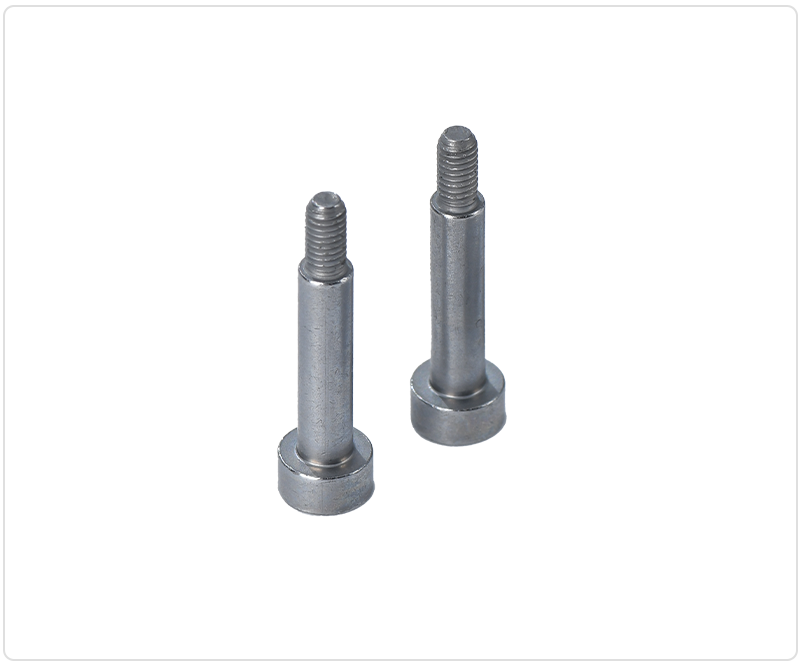
Socket Head Shoulder Screws, also known as Shoulder Screws, are precision fasteners designed with a smooth shoulder between the head and threaded section. This shoulder functions as a bearing surface, guide, pivot, or locating shaft, allowing moving components to rotate or slide accurately while minimizing wear.
Unlike ordinary screws, Socket Shoulder Screws are manufactured with strict dimensional tolerances, making them ideal for applications that require consistent positioning and long-term reliability. The internal hex socket head also allows installation in confined spaces while providing high tightening torque.
Typical applications include automation equipment, robotic systems, CNC machining centers, semiconductor machinery, medical devices, packaging equipment, and precision molds.
What Are Shoulder Bolts?
Shoulder Bolts also feature a smooth shoulder located between the head and the threaded section. In many industrial catalogs, the terms Shoulder Screws and Shoulder Bolts refer to similar products. However, shoulder bolts are generally selected for applications where extremely high positioning accuracy is not required.
Compared with Precision Shoulder Bolts used in precision machinery, standard shoulder bolts often have wider manufacturing tolerances and are commonly used in equipment frames, fixtures, construction machinery, and heavy-duty mechanical assemblies.
5 Key Differences Between Socket Head Shoulder Screws and Shoulder Bolts
1. Manufacturing Precision
The biggest difference is manufacturing accuracy. Precision Shoulder Screws are machined with tighter tolerances to provide smooth rotation and accurate positioning. This precision is critical for robotics, automation equipment, and other high-performance machinery.
Standard Shoulder Bolts are suitable for general fastening tasks where slight dimensional variation will not affect equipment performance.
2. Primary Function
Although both products secure components together, Shoulder Screw Fasteners are primarily designed to serve as shafts, pivots, bearing surfaces, and locating pins. They help ensure precise movement while reducing friction and wear.
Shoulder bolts mainly provide structural fastening while allowing limited movement between connected parts.
3. Typical Applications
Choose Socket Head Shoulder Screws for applications requiring precision motion, including:
Industrial automation
Robotic equipment
CNC machining
Medical devices
Packaging machinery
Electronic manufacturing
Choose Shoulder Bolts for applications such as:
Industrial fixtures
Agricultural machinery
Construction equipment
Machine frames
General mechanical assemblies
4. Installation and Maintenance
The internal hex design of Shoulder Socket Screws allows installation in compact spaces while providing reliable tightening torque. Their precision shoulder also reduces wear during repeated movement, extending component service life.
Regular inspection of shoulder wear, thread condition, and tightening torque helps maintain optimal performance regardless of which fastener is selected.
5. Cost and Long-Term Value
Because of their tighter machining tolerances and higher manufacturing standards, Socket Head Shoulder Screws generally cost more than standard Shoulder Bolts. However, they often reduce downtime, improve positioning accuracy, and lower long-term maintenance costs, making them a better investment for precision equipment.
Which One Should You Choose?
If your application involves precision movement, rotating components, or accurate positioning, Socket Head Shoulder Screws are the recommended solution. Their high accuracy and durability make them ideal for demanding industrial environments.
If your project mainly requires reliable fastening for structural assemblies or general industrial equipment, Shoulder Bolts provide a practical and cost-effective choice.
Can Socket Head Shoulder Screws Be Customized?
Yes. Most professional manufacturers provide OEM and custom manufacturing services for Socket Head Shoulder Screws, including custom shoulder diameter, shoulder length, thread size, materials, heat treatment, surface finishes, and packaging based on customer drawings.
Customized Precision Shoulder Screws help optimize equipment performance while meeting specific engineering requirements.
F&Q
Are Shoulder Screws and Shoulder Bolts the same?
They are closely related products, but Socket Head Shoulder Screws generally emphasize higher precision and are better suited for applications requiring controlled movement.
Why are Precision Shoulder Screws widely used in automation equipment?
Automation systems require repeatable positioning and smooth movement. Tight machining tolerances help reduce wear and improve equipment accuracy.
Can Shoulder Screw Fasteners be manufactured according to drawings?
Yes. Most experienced manufacturers can produce custom Shoulder Screw Fasteners according to engineering drawings, technical specifications, and OEM requirements.
Which material is best for Shoulder Socket Screws?
The best material depends on the application. Stainless steel offers excellent corrosion resistance, while alloy steel provides higher strength for heavy-duty industrial environments.
```
