


self-drilling screws and self-tapping screws are often considered similar because both are designed to create a fastening connection without requiring a conventional nut. However, they are not exactly the same. The main difference is in their working principle and screw-point design.
A self-drilling screw has a drill-shaped point that can penetrate the material and create a hole during installation. A self-tapping screw is mainly designed to cut or form threads inside a pre-drilled hole. Understanding this difference can help you select the right fastener for sheet metal, machinery, automotive components, construction, and other applications.
Self-Drilling Screws vs. self-tapping screws
The easiest way to distinguish them is by looking at the tip.
Self drilling screws have a drill-point tip, similar to a miniature drill bit. When the screw rotates, the tip penetrates the workpiece and creates a pilot hole. The threads then engage with the material, allowing drilling and fastening to happen in one operation.
Self-tapping screws normally have a sharp or pointed tip but do not necessarily have a drill-bit point. They are designed to create or form their own threads as they enter a prepared hole. Depending on the design, they can be thread-cutting or thread-forming screws.
In simple terms, self-drilling screws can drill and fasten, while self-tapping screws primarily tap or form threads.
How Do Self-Drilling Screws Work?
The working process of a self-drilling screw can be divided into three basic stages.
First, the drill point penetrates the surface of the material. As rotational force is applied, it removes material and creates a hole. Next, the screw thread enters the hole and engages with the surrounding material. Finally, the screw head reaches the surface and generates the required clamping force.
This design eliminates the need for a separate drilling step in many applications. It is especially useful for thin sheet metal and light-gauge steel where fast installation is important.
The drilling performance depends on factors such as drill-point geometry, screw hardness, material thickness, installation speed, and applied pressure.
How Do Self-Tapping Screws Work?
Self-tapping screws work by creating or forming threads in the material.
In many applications, a pilot hole is prepared before installation. When the screw enters the hole, its thread cuts into or displaces the surrounding material. This creates a mating thread that holds the screw in position.
Thread-cutting screws remove material to create threads, while thread-forming screws mainly displace the material. The choice depends on the workpiece and the required fastening performance.
This is why self-tapping screws are commonly used for metal, plastic, and other materials where controlled thread engagement is required.
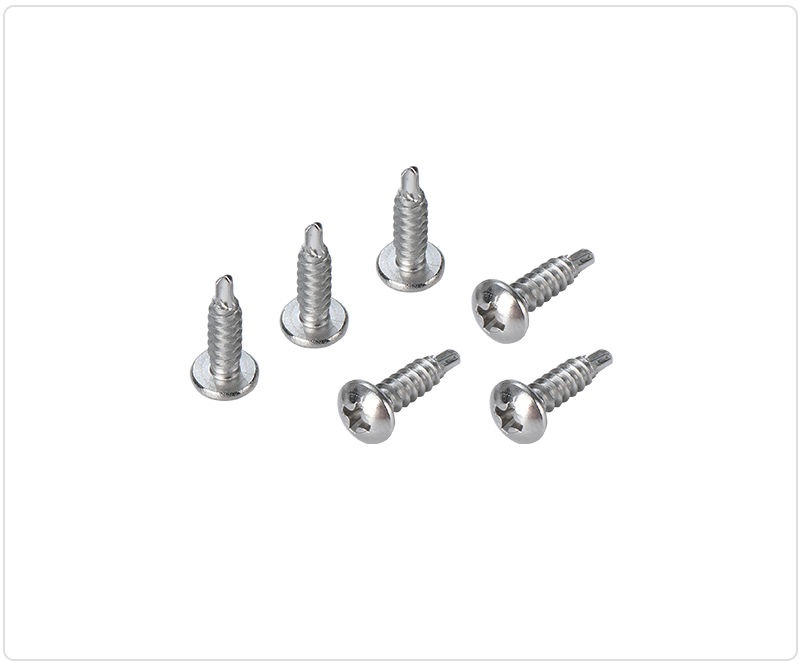
Manufacturing Process
Although the designs are different, both types of screws can use similar manufacturing processes.
Production usually starts with steel wire, which is formed into the screw head and shank through cold heading or cold forming. The threads are then produced, often through thread rolling, which provides consistent thread dimensions and good mechanical performance.
For self-drilling screws, the drill point requires additional attention because its geometry determines drilling efficiency. The screws may then undergo heat treatment to achieve the required hardness and toughness.
Surface treatment is another important step. Zinc plating, Zinc-Nickel Coating, and other finishes can improve corrosion resistance and make the fastener suitable for different working environments.
Quality inspection may include checking dimensions, thread accuracy, hardness, coating thickness, and drilling performance.
Materials Used
Carbon steel and alloy steel are widely used for industrial fasteners because they provide a good balance of strength, hardness, and cost.
Stainless steel, such as 304 or 316, may be selected when greater corrosion resistance is required. The appropriate material depends on the application, working environment, substrate, and expected service life.
Surface coating is also important. For outdoor or humid applications, a suitable protective coating can help reduce corrosion and maintain fastening performance.
Advantages and Disadvantages
Self-drilling screws are popular because they combine drilling and fastening into one operation. Their main advantages include faster installation, fewer assembly steps, and convenient use with power tools.
However, they have limitations. The drill point is designed for specific material thicknesses and hardness levels. Using the wrong screw for thick or hard steel can result in poor drilling performance or point damage.
Self-tapping screws offer greater flexibility in thread design and can be used with different materials. They are suitable when a pilot hole has already been prepared or when a specific hole size is required.
Their main disadvantage is that a separate drilling or punching process may be necessary before installation.
Common Applications
Self-drilling screws are widely used in sheet metal, roofing, HVAC systems, metal panels, steel framing, electrical enclosures, and general construction.
Self-tapping screws are commonly found in machinery, automotive components, appliances, electrical equipment, plastic assemblies, and metal fabrication.
For example, a manufacturer assembling thin metal panels may prefer self-drilling screws to reduce installation time. For a plastic housing that already has a designed pilot hole, a suitable self-tapping screw may provide better thread engagement.
Which Screw Should You Choose?
The choice depends on the material, thickness, hole requirements, and installation method.
Choose a self-drilling screw when you need the fastener to drill its own hole and complete installation in one operation. Choose a self-tapping screw when the application already has a pilot hole or requires a specific thread-forming process.
Other factors should also be considered, including screw diameter, thread pitch, head style, drive type, material, hardness, coating, and corrosion resistance.
Conclusion
Self-drilling screws and self-tapping screws are related, but they are not the same. The key difference is their point design and primary function. Self-drilling screws combine drilling and fastening, while self-tapping screws are mainly designed to create or form threads in a prepared hole.
Selecting the right screw requires considering the workpiece material, thickness, installation method, and required fastening performance. With the correct screw design and material, both types can provide an efficient solution for industrial and commercial fastening applications.
