


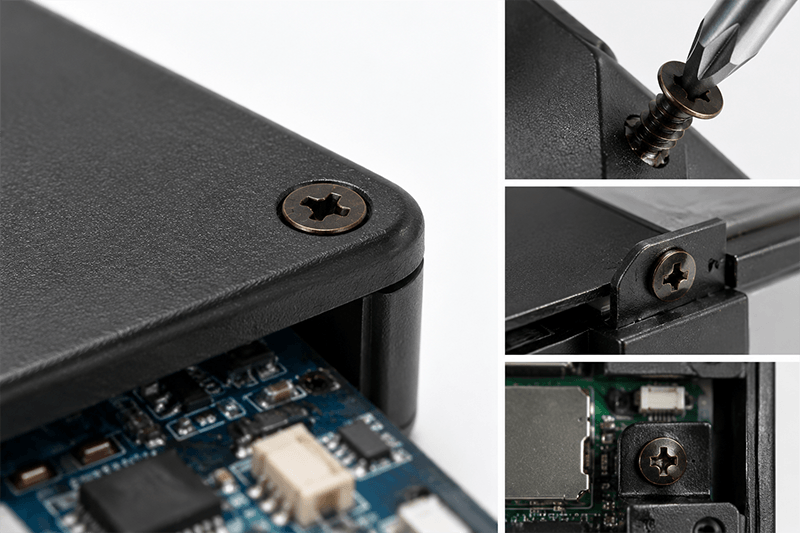
Small self tapping screws are widely used in electronic housings because they create secure threaded connections in compact assemblies without requiring a preformed thread in many applications. They help manufacturers fasten plastic covers, control panels, sensor housings, circuit enclosures, and other electronic components while reducing assembly time and minimizing the space needed for fastening.
However, choosing the right self tapping screws involves more than selecting a small diameter. Thread geometry, material hardness, point design, head shape, coating, and installation torque all influence fastening reliability. For electronics manufacturers and B2B buyers, understanding these factors helps prevent cracked enclosures, stripped threads, loose joints, and inconsistent assembly quality.
Why Small Self-Tapping Screws Suit Compact Electronic Housings
Electronic housings often contain closely spaced mounting bosses, thin walls, and delicate internal components. Large fasteners may require more material, occupy valuable space, or interfere with circuit boards and wiring. Small self tapping screws provide sufficient retention for lightweight covers and compact structural parts when their dimensions and installation conditions are properly matched to the application.
Unlike conventional Machine Screws, self-tapping screws form or cut mating threads as they enter a suitable pilot hole. This can reduce the need for separate tapping operations and simplify automated assembly. The exact mechanism depends on the screw design: thread-forming screws displace material, while thread-cutting designs remove material to create the thread.
For electronics manufacturers, the main benefit is a balance between compact dimensions, fastening strength, assembly speed, and manufacturing cost. The screw must provide adequate clamping force without damaging the housing or nearby components.
How Thread Design Affects Plastic Enclosure Reliability
Plastic housings require particular attention because their strength and deformation behavior differ from those of metal components. Thread pitch, flank geometry, major diameter, and engagement length determine how forces are distributed between the screw and the plastic mounting boss.
A thread that is too aggressive or a screw with an unsuitable diameter may remove excessive material, split the boss, or cause localized stress. Conversely, insufficient thread engagement can result in pull-out failure or loosening during vibration. Plastic type also matters: ABS, polycarbonate, nylon, and glass-filled polymers have different stiffness, toughness, and creep characteristics.
When selecting self tapping screws for plastic enclosures, engineers should evaluate the pilot-hole diameter, boss geometry, wall thickness, and required installation torque together. A pilot hole that is too small increases driving torque and cracking risk, while an oversized hole reduces thread engagement.
Manufacturers should validate the combination using representative housing materials rather than relying only on nominal screw dimensions. Installation-torque monitoring, thread-stripping tests, and pull-out testing help identify problems before mass production.
How Small Self-Tapping Screws Are Manufactured
Consistent performance begins with wire selection and forming. Steel wire must have suitable chemical composition, diameter tolerance, and cleanliness. Material inconsistencies can affect cold heading, heat treatment, hardness, and final mechanical performance.
During cold heading, forming dies shape the screw head and basic blank. Die condition, lubrication, forming pressure, and material ductility influence head dimensions and surface quality. Poor process control may cause cracks, folds, incomplete head formation, or dimensional variation that affects driver engagement and clamping.
Thread rolling then forms the threads by pressing the blank between hardened dies. This process can produce consistent thread profiles and a work-hardened surface. Die wear, blank diameter, alignment, and rolling pressure affect thread pitch, major diameter, minor diameter, and flank geometry. Incorrect dimensions can increase driving torque or reduce thread retention.
Heat treatment is used when required to achieve the specified hardness and mechanical properties. The process must balance surface hardness with core toughness. Excessive hardness or an unsuitable heat-treatment cycle can increase brittleness and the risk of screw breakage, while insufficient hardness may reduce thread durability.
Surface finishing follows according to the required corrosion resistance, appearance, and application. Plating or coating thickness must be controlled because excessive buildup can affect thread fit and drive recess dimensions. For electronic applications, buyers should also consider corrosion requirements and whether the coating is compatible with the intended environment.
Final inspection should verify dimensions, thread quality, hardness where specified, drive recess condition, surface defects, and coating consistency. Sampling plans and traceable production records help manufacturers maintain consistency between batches.
Why Head Style Matters in Electronic Assemblies
Head geometry affects clearance, load distribution, appearance, and tool access. The correct choice depends on the housing design and the function of the fastening point.
Countersunk self tapping screws are useful when a housing requires a relatively flush surface. However, the countersink angle and depth must match the screw head. An incorrect countersink can cause the head to sit too high, create excessive local stress, or reduce the material available to support the fastener.
Phillips Self Tapping Screws are common in general assembly because their drive recess is widely recognized and compatible with established tooling. However, the driver must match the recess size, and installation torque must be controlled to reduce cam-out, recess damage, and inconsistent seating.
Pan-head and other raised-head designs may be preferable when a countersink is unnecessary or when the housing needs a larger bearing surface. During product design, engineers should consider driver access, available clearance, required clamping force, and the risk of damaging nearby electronic components.
Choosing Self-Tapping Screw Sizes for Electronics
Correct self tapping screw sizes depend on the housing material, pilot-hole diameter, wall thickness, required engagement, and expected service loads. Diameter alone does not determine whether a fastener will perform reliably.
For plastic housings, the mounting boss must provide sufficient material around the pilot hole. The screw length should provide adequate engagement without penetrating the enclosure wall or contacting internal circuit boards, wires, or other components.
Engineers should also account for manufacturing tolerances. Variations in molded pilot holes, screw diameter, and boss position can change installation torque and joint strength. Tolerance stack-up is especially important in automated assembly, where inconsistent driving conditions may lead to stripped threads or incomplete seating.
Validation should include representative minimum and maximum dimensions, installation-torque limits, pull-out strength, and repeated assembly where maintenance requires screw removal. For critical applications, testing should also consider temperature changes, vibration, and long-term plastic creep.
Material Selection and Corrosion Resistance
Carbon steel is commonly selected when strength and cost efficiency are priorities. Stainless steel may be appropriate for humid environments or applications with specific corrosion requirements. The final choice depends on the required mechanical properties, exposure conditions, coating, and compatibility with the housing materials.
Heat treatment and surface finishing must be coordinated. A coating that improves corrosion resistance may alter friction during installation, changing the relationship between driving torque and clamping force. This is important because excessive torque can damage plastic bosses even when the screw itself remains intact.
Manufacturers should inspect coating coverage, thickness where specified, and surface defects. Corrosion testing may be required according to the application specification. For certain high-strength steel fasteners, plating processes also require appropriate evaluation of hydrogen embrittlement risk.
Quality Tests That Matter for Electronic Housing Screws
Dimensional inspection confirms that the screw matches the approved drawing and relevant product standards. Critical characteristics include thread diameter, pitch, length, head dimensions, drive recess geometry, and point configuration. Optical measurement systems and suitable gauges can help detect variations that affect assembly.
Mechanical testing evaluates whether the screw can withstand the intended loads. Depending on the specification, checks may include hardness, torsional strength, driving performance, and resistance to breakage. For screws installed in plastic housings, testing the complete screw-and-enclosure combination is particularly important.
Installation tests reveal issues that isolated screw measurements cannot detect. Excessive driving torque may indicate an undersized pilot hole, unsuitable thread geometry, coating variation, or material inconsistency. Pull-out and stripping tests help verify that the joint retains sufficient strength without damaging the enclosure.
Quality control should establish measurable acceptance criteria before production begins. Inspection results, material batches, heat-treatment records, coating data, and corrective actions should be traceable when required by the customer's quality system.
When Custom Self-Tapping Screws Are Worth Considering
Custom self tapping screws may be appropriate when standard fasteners cannot meet the required head clearance, thread engagement, drive access, corrosion resistance, or assembly performance. Customization may involve screw length, head shape, thread geometry, point design, material, or surface finish.
Before approving a custom design, buyers should provide engineering drawings, housing material details, pilot-hole dimensions, installation-torque requirements, and relevant environmental conditions. Samples should be tested in the actual enclosure or a representative production component.
Changes to thread geometry or heat treatment can affect both fastening strength and manufacturability. Manufacturers should therefore confirm tooling feasibility, process capability, inspection methods, and validation requirements before mass production. A custom fastener should solve a demonstrated engineering problem rather than introduce unnecessary complexity.
What B2B Buyers Should Ask a Self-Tapping Screw Manufacturer
When sourcing small fasteners for electronic housings, buyers should evaluate manufacturing capability alongside price and delivery time. Useful questions include:
Can the supplier maintain consistent thread and head dimensions across production batches?
What material, hardness, and coating options are available?
Can the manufacturer provide dimensional inspection and mechanical test reports?
Can installation torque and pull-out performance be validated using the customer's housing material?
Are custom dimensions, samples, packaging, and batch traceability available?
A capable supplier should be able to explain how forming, thread rolling, heat treatment, and surface finishing affect finished fastener performance. For OEM buyers, this process knowledge is valuable because it helps prevent recurring assembly defects and reduces the risk of inconsistent fastening quality.
Small self tapping screws are widely used in electronic housings because they support compact designs and efficient assembly. Their reliability depends on matching thread geometry, dimensions, material, head style, and installation conditions to the housing design.
For electronics manufacturers, the best results come from validating the complete fastening joint rather than selecting screws by size alone. Working with an experienced fastener supplier that controls manufacturing processes and provides appropriate inspection data helps improve assembly consistency, reduce enclosure damage, and support dependable production.
