


self tapping screws are designed to form or cut their own threads as they are driven into a material, reducing the need for a separately threaded hole. You can often identify them by examining the screw tip, thread geometry, and intended application. However, appearance alone is not always sufficient because self-tapping screws come in different designs for metal, plastic, and other materials.
For industrial buyers, wholesalers, and importers, identifying the correct screw also means understanding how its manufacturing process affects thread formation, driving torque, fastening strength, and dimensional consistency. These factors are particularly important when sourcing small self tapping screws, fasteners for electronic enclosures, and customized Fastening Components.
What Features Identify a Self-Tapping Screw?
The most useful identification feature is the relationship between the tip and the threads. Many self-tapping screws have a pointed tip and sharp, defined threads that engage with the material during installation. Some designs use a cutting tip or flutes to remove material, while thread-forming designs displace material to create a mating thread.
A conventional self-tapping screw generally does not require a pre-threaded hole, although a pilot hole may be necessary depending on the material, screw diameter, and application. This distinguishes it from a machine screw, which normally requires an existing matching thread or a threaded insert.
Do not confuse all pointed screws with self-tapping screws. Wood screws, drywall screws, and certain specialized fasteners may also have pointed tips, but their thread profiles and intended applications differ. The correct identification should consider the manufacturer's product specifications rather than tip shape alone.
How Thread Geometry Distinguishes Different Screw Types
Thread geometry determines how a screw engages with the workpiece. Thread pitch, thread depth, flank angle, major diameter, minor diameter, and tip design influence installation torque and the resulting joint strength.
Self-cutting designs remove material as the screw advances. Thread-forming designs displace material instead, creating a mating thread without cutting away as much material. The latter can be useful in suitable ductile materials, but the required installation torque and risk of material cracking depend on the substrate and screw design.
When identifying an unfamiliar fastener, inspect the thread profile under adequate lighting or magnification. Look for a defined working tip, continuous threads, and a geometry appropriate for the intended substrate. If the tip is damaged or the threads are poorly formed, the screw may be difficult to identify reliably.
For procurement teams, drawings and technical datasheets should specify the intended material, thread dimensions, point style, and installation requirements. These details are more reliable than descriptions such as sharp screw or pointed screw.
How Manufacturing Processes Affect Screw Identification and Performance
Most mass-produced steel self-tapping screws begin with wire rod that is processed to meet the required material and mechanical properties. The wire is drawn to the appropriate diameter, cut into blanks, and formed into a head and point using cold heading. Thread rolling then forms the threads by pressing the blank between hardened dies.
Thread rolling is important because it forms the thread profile without removing material in the same way as conventional thread cutting. Die geometry, blank diameter, alignment, and tool wear influence thread height, pitch, root geometry, and consistency. Poor control can produce incomplete threads or dimensional variation that affects installation and holding performance.
The point may be formed during heading or through a subsequent operation, depending on the design. Its shape must be consistent with the intended application. A point that is too blunt may increase starting torque, while an incorrectly formed cutting tip may fail to create the intended thread.
Heat treatment is commonly used for carbon-steel and alloy-steel fasteners when the specified hardness and mechanical properties require it. The process must balance strength and toughness. Excessive brittleness can increase the risk of breakage during installation, while insufficient hardness may cause thread damage or poor penetration into the target material.
Surface finishing, such as zinc plating or another specified coating, provides corrosion protection and can influence friction during installation. Coating thickness and uniformity matter because excessive buildup may affect thread fit, while inadequate coverage can reduce corrosion resistance. Hydrogen embrittlement controls may also be necessary for applicable high-strength steel fasteners following certain surface treatments.
Which Quality Checks Confirm a Self-Tapping Screw Is Correctly Made?
Visual inspection is useful for detecting obvious defects, but it cannot establish all functional characteristics. A reliable quality-control program combines dimensional measurement, material verification, mechanical testing, and application-specific performance checks.
Thread inspection: Verify pitch, diameter, thread height, and profile using suitable gauges or optical measurement equipment.
Tip inspection: Check point geometry, sharpness, symmetry, and the presence of specified cutting features.
Head and drive inspection: Confirm head dimensions, recess geometry, and driver engagement to reduce slipping or cam-out.
Hardness and mechanical testing: Verify that the material and heat treatment meet the applicable specification.
Coating inspection: Evaluate coating thickness, coverage, and corrosion resistance according to the agreed requirements.
Functional testing: Test installation torque, thread formation, and holding performance in representative materials.
For production lots, sampling plans and acceptance criteria should be agreed upon before shipment. Tests must use the specified substrate and pilot-hole conditions because a screw that performs well in one material may not perform equally well in another.
How to Identify Self-Tapping Screws for Metal, Plastic, and Electronics
The material being fastened is a major clue when selecting or identifying the appropriate screw. A design intended for sheet metal may not be suitable for a thin plastic enclosure or a compact electronic assembly.
Metal applications: Screws for sheet metal typically use thread geometry suited to the metal's thickness and hardness. Some require a prepared hole, while specialized self-drilling designs can create their own entry hole. Self-drilling and self-tapping describe different functions: drilling refers to creating the hole, while tapping refers to forming the mating thread.
Plastic enclosures: Self tapping screws for plastic enclosures should be selected according to the plastic type, wall thickness, boss geometry, and required assembly cycles. Thread design must balance holding strength against the risk of splitting, stress concentration, or stripped plastic. The recommended pilot-hole diameter and installation torque are particularly important.
Electronic assemblies: Self tapping screws for electronics may be used to secure plastic housings, brackets, covers, or other components. Buyers should consider the available clearance, screw length, head profile, electrical isolation requirements, and risk of damaging nearby circuit boards or internal components. Small dimensions make dimensional consistency especially important.
How Head Style and Drive Type Help Identify a Screw
The head and drive provide additional identification clues, but they do not independently confirm whether a screw is self-tapping. Head style determines how the fastener sits against the workpiece, while the drive type determines how installation torque is applied.
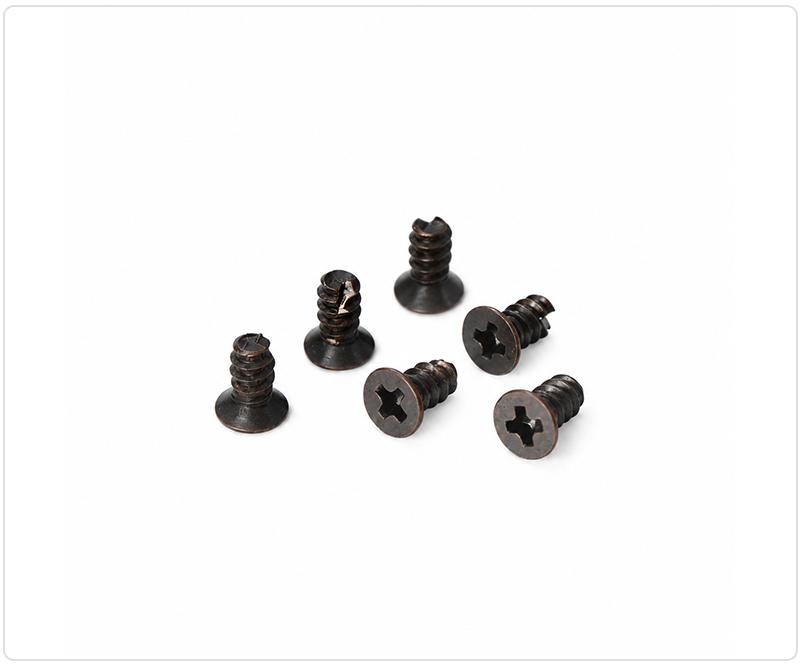
Countersunk self tapping screws are designed to sit flush with a suitably prepared countersunk surface. Incorrect countersink geometry or excessive tightening can damage the material or prevent proper seating.
Phillips Self Tapping Screws use a cross-shaped drive recess. The correct driver size is essential because a poor fit increases the risk of cam-out and recess damage. Phillips drives are available with different head styles, so buyers should specify the head shape and drive separately.
For small self tapping screws, recess depth, head diameter, and dimensional tolerances deserve particular attention. Minor manufacturing deviations can make automated feeding and installation less reliable.
How to Select the Correct Self-Tapping Screw Sizes
Choosing self tapping screw sizes involves more than measuring the overall length. Buyers should consider nominal diameter, thread pitch, head dimensions, point length, and the thickness of the materials being joined.
A screw that is too short may provide insufficient engagement, while an excessively long screw may interfere with internal components or protrude through the workpiece. An unsuitable diameter or pilot hole can increase installation torque, weaken the joint, or damage the substrate.
For repeat orders, provide a dimensioned drawing or a verified sample along with material, finish, tolerance, and performance requirements. This reduces ambiguity between suppliers and helps ensure that replacement batches remain compatible with existing production equipment.
What Should Buyers Check When Ordering Custom Self-Tapping Screws?
Custom self tapping screws may require special dimensions, head configurations, thread profiles, materials, coatings, or packaging. Before placing a bulk order, buyers should confirm that the proposed design matches the actual fastening conditions.
Provide the supplier with the substrate material, workpiece thickness, required screw dimensions, installation method, expected service environment, and any applicable mechanical or corrosion requirements. If the fastener will be installed automatically, include information about feeding equipment and driver limitations.
Ask the manufacturer to confirm drawing tolerances, material specifications, inspection methods, sample approval procedures, and production-lot traceability. For new designs, prototype testing should verify installation torque, thread formation, pull-out performance where relevant, and resistance to stripping or breakage.
F& Q
Can I identify a self-tapping screw by its pointed tip?
A pointed tip is a useful clue, but it is not conclusive. Check the thread profile, intended substrate, and product specifications to distinguish self-tapping screws from other pointed fasteners.
Do self-tapping screws always need a pilot hole?
No. Requirements depend on the screw design and material. Many applications use a pilot hole to control installation torque and reduce the risk of material damage.
Are self-tapping and self-drilling screws the same?
No. Self-tapping screws form or cut mating threads, while self-drilling screws have a drill-point design intended to create the entry hole as well. A self-drilling screw can also form threads, but the terms describe different functions.
What information should I provide when sourcing self-tapping screws?
Provide dimensions, material, head and drive types, surface finish, substrate, installation conditions, and performance requirements. Drawings or approved samples help manufacturers confirm the correct specification.
You can often recognize self tapping screws by their thread geometry and working tip, but reliable identification also requires checking the intended material and technical specifications. Manufacturing quality, heat treatment, thread rolling, coating control, and functional testing determine whether a screw performs consistently in its application.
For wholesalers, importers, and industrial buyers, working with a qualified fastener manufacturer and specifying measurable requirements helps ensure consistent quality, reliable installation, and suitability for the intended assembly.
